

.
January
5, 2005
.
This Week:
-
Consortium for vehicle-to-vehicle communications sets to work
-
Acura RD-X Concept Debuts at North American International Auto Show
-
Bentley Motors to produce the world’s most exclusive limousine
-
Ford's F-Series now for 28 Years in the Market, still going strong
-
Mazda’s MX-Crossport Concept to Debut at 2005 North American International Auto Show
-
Dana Corporation Announces Outsourcing of Grey Iron Castings
© 1998
- 2005 Copyright &
Disclaimer
Automotive Intelligence,
www.autointell.com
All Rights Reserved .
For questions please contact
editor@autointell.net
.
Mazda’s MX-Crossport Concept to Debut at 2005 North American International Auto Show

|
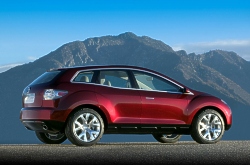
The MX-Crossport was designed at Mazda’s main design studio in Hiroshima; it is a crossover-type vehicle—a very Mazda crossover that combines the strong, sports car styling motif of the company’s flagship RX-8 with the more practical packaging of a sport-utility vehicle (SUV). The powerful, bold, three-dimensional identity of the concept car was created to be both surprising and uniquely eye-catching, but at the same time clearly a Mazda, strong with Mazda family design cues that are noticeable even from a distance. It is also a new frontier for Mazda, leading the company into a new segment, expanding the definition of Zoom-Zoom from both a design and packaging standpoint. |
|
“Mazda has momentum right now and one of our immediate challenges is to harness this momentum and create new products that will help us strengthen our results in the major markets around the world,” stated Moray Callum, design director of Mazda Motor Corporation. “We challenged our design team to further evolve and expand our existing design DNA. The result of this challenge is the MX-Crossport, which was designed first-and-foremost with the North American market and style of driving in mind. We are always working to expand our showroom in North America and look for opportunities in other key markets as well.”
ADVANCED FRONTIER DESIGN CONCEPT
Design is an important element of all Mazda products and, as such, the MX-Crossport is first-and-foremost a design concept. Chief Designer Iwao Koizumi, whose previous works include the successful Mazda6, calls this concept an “advanced frontier” for Mazda, meaning the concept merges the speedy and athletic image of Mazda’s best sports car with the toughness and practicality of an SUV. The result is a vehicle that takes Mazda and its Zoom-Zoom image into an area it has never before ventured.
“Our goal was to design a crossover that transcends the existing categories of SUV and crossovers and steps into the realm of sports car. We want to let people experience the world of sports cars every time they get behind the wheel,” Iwao Koizumi added.
The MX-Crossport communicates a sense of motion and speed with its bold exterior design. It represents Mazda’s Zoom-Zoom spirit with its sporty appearance and at the same time provides many innovative elements and a comfortable interior atmosphere with ample space for four adults.
Chief designer Iwao Koizumi expresses his confident stance in the design by stating, “Design language in a product like this is very important. No matter what the powertrain is, the design must have the same powerful Zoom-Zoom language. The cockpit has also been designed to perfectly match the powerfulness of the exterior design.”
SPORTY, POWERFUL EXTERIOR DESIGN
The concept’s athletic image is reflected in its overall size. At 4,630 mm in length, the MX-Crossport is compact, agile and relatively small compared to other key products in the emerging crossover segment.
At the same time, to provide the vehicle with an ideal, confident stance, the design is highlighted by a low and wide exterior measuring 1,930 mm in width, with short front-and-rear overhangs and a relatively long wheelbase of 2,795 mm. The tires are relatively large as well, measuring 275/45. The emphasis of a long wheelbase and large tires help accentuate the concept’s sporty, stable appearance. At an overall height of 1,630 mm, the MX-Crossport is low compared to traditional small SUV-type vehicles such as Mazda’s own Tribute, while maintaining an aggressive off-highway look.
Viewed from the front, key features of the design include the distinct, flowing lines that run down from the A-pillars at a soft angle along the hood and down into the grille area; these strong lines neatly contrast with the very prominent front fenders. Additionally, the wide, lower grille opening is a new hallmark being used by Mazda in its sports family, as can be seen on the Mazda RX-8 and the high-performance, turbocharged MPS version of the Mazda6. Likewise, the strong, independent front fender of the RX-8 is now a typical figurative motif for Mazda sports cars and this feature is incorporated into the MX-Crossport to help balance the evolution and the tradition.
The MX-Crossport also demonstrates how side windows are becoming an important dynamic pattern for Mazda design. In this case, the flowing roofline is complimented by a stronger beltline that boldly kicks upward as it reaches the rear fender. The strong beltline and the narrowing of the rear windows as they stretch over the rear fenders is a key design element that adds to the concept’s overall sporty image.
The design also features a cabin that three-dimensionally narrows towards the rear of the vehicle, working in harmony with the narrowing window graphic.
In contrast to the narrowing cabin, the rear fenders of the MX-Crossport design reach their volume peak immediately above the rear wheels. The strong rear fenders compliment the aggressive five-spoke wheels, which are based on a design first used by Mazda nearly a decade ago on the Koizumi-designed RX-01, a precursor to the current Mazda RX-8.
When viewed directly from the rear, the key design highlights are the compact, narrowing cabin, the rich, strong shoulders communicated by the rear fenders and the round motif of the tail lamps. Also, common to the characteristics of other Mazda sports cars are the graphics of the lower bumper, including integrated exhaust system.
Attention to detail can be seen throughout the exterior design, from the integrated exhaust system to the round, cylinder motif of the headlamps and tail lamps. Even the towing hitch is retractable so it can be neatly stowed within the rear bumper housing and out of sight when not in use.
The exterior colour—a newly created colour called “K2 Red”—is another important detail in completing the exterior design of the concept. The colour was carefully chosen to emphasize and communicate the image of the car. It is reminiscent of the famous red earth of Utah’s Monument Valley in the United States—the strong, magnificent imagery of red earth is mingled into the exterior colour and compliments well the light, modern colours of the advanced interior.
ATHLETIC AND FUTURISTIC INTERIOR DESIGN
The interior of the MX-Crossport design concept was developed to visually present an athletic, Zoom-Zoom theme that is similar to the exterior, with special attention placed on creating an atmosphere of quality and craftsmanship. Like the flagship Mazda RX-8, the MX-Crossport features four buckets seats—it is more sports car than family car. The interior presents an overall environment of comfortable driving pleasure, with an emphasis on driving.
When viewed from the exterior, the cabin is small and compact, but special design measures were taken to create an interior space that is both roomy and modern in appearance. Key to delivering the feeling of room and space are the “floating” seats; each seat is fastened to the floor with a single, centre-mounted post and adjustable via a “monorail” system mounted in the floor. With generous amounts of high-quality, semi-aniline leather, a black mesh highlight line running down the centre and integrated safety belts, the seats present a modern and sporty image. Further emphasizing the high tech image, and surely a pleasure to look at from the rear seats, are the backs of the front seats, which are aluminium and acrylic, with the well-designed mechanism of the safety belts clearly visible, not unlike the back of a high-class, mechanical wristwatch.
Additionally, when the individual rear seats are folded down, they connect neatly to the rear cargo area, providing sufficient, easy-to-access storage space.
From the driver’s seat, the view is pure Mazda RX-8, with a three-dial instrument cluster and a thick, three-spoke steering wheel. The cock-pit-type driver’s area is defined by a small meter hood placed just in front of a large “roof” that stretches across the entire instrumental panel—called a “double roof”—at the base of the windshield. The double roof has the effect of unifying the front of the cabin, bringing together the driver and front passenger.
The ceiling of the MX-Crossport is made up almost entirely of glass, which adds to the open, airy feeling of the interior. This large, variable-mist glass roof can be operated to change from clear to translucent white and back again instantly. Being able to adjust the amount of light flowing into the vehicle in this manner enriches the comfort of the cabin space.
The ceiling of the cabin also features a neatly integrated and highly flexible overhead console, running the length of the vehicle, which is able to accommodate various attachments such as a rear entertainment display and a range of additional storage compartments.
Three Panel Display System Advances the Zoom-Zoom Driving Experience
The MX-Crossport features an advanced, multi-use information display and entertainment system that is designed to be intuitive and easy to use. The Three Panel Display system brings together three important features—a hemispherical monitor which can be used as a touch panel (called the “handling panel”) mounted above the centre console, just to the right of the steering wheel; a second “status monitor” mounted above the handling panel; and a third “entertainment monitor” to the right, mounted immediately ahead of the front passenger.
The information portion of the Three Panel Display (the handling panel and status monitor) features numerous driving support functions such as vehicle diagnosis upon engine start-up, safety instructions, monitoring of blind spots, parking guidance, satellite navigation system and emergency information. Additionally, the system features basic audio and climate controls functions and can be used to send and receive e-mails and provide Internet access. The handling panel and status monitor are carefully positioned within the instrument panel to be easy to use for the driver and not distracting to the overall driving experience. The two screens are neatly integrated into the overall vehicle design.
The third element of the Three Panel Display, the entertainment monitor, is designed to help share the driving excitement with the front passenger by providing a “virtual view” from the driver’s seat and beyond. Using a unique 365 mm x 80 mm (15” wide) liquid-crystal display screen and five cameras, the entertainment monitor offers four unique views of the road. Specifically, there are the Driver’s Eye View, Front Wheel View, Super Low Angle and the Rear Wheel View.
Driver’s Eye View, for example, offers a view of a real-time display of the three-dial instrument cluster from the driver’s seat. Front Wheel View, conversely, offers a three-screen view of the road ahead (the Driver’s Eye View, plus a view from cameras mounted in each of the two side-view mirrors), not unlike a popular racing video game. Also, the entertainment monitor can also be switched to DVD mode for the front passenger during a long drive.
High Quality Utility with a Mind for Innovation
A number of unique, high-quality features with a touch of innovation are incorporated throughout the MX-Crossport’s interior. The gearshift lever, for example, features two distinct positions for the two drive modes—automatic and manual. In automatic mode, the gearshift is tilted forward to lie nearly flat on the centre console and gears (reverse, drive, park, etc.) can be chosen with the simple push of a button on the topside of the gearshift lever. For manual mode, the gearshift can be lifted to stand upright and can then be used as a plus/minus lever to manually select gears while driving.
A power-retractable tonneau cover neatly covers the rear storage area, which features ample space for approximately three golf bags behind the rear seats.
Overall—as with the exterior—the dynamic nature of the interior design was created to communicate a visual sense of motion and speed and to test potential design themes that could be incorporated into a production model.
While Mazda has not yet officially confirmed a production model based on the MX-Crossport, the company has clearly stated that it intends to expand its line up of new-generation Zoom-Zoom products for the North American market and beyond. The MX-Crossport is an important step forward in this process.
(Dec. 20, 2004)
| .
Homepage News Companies Management Publications Events Guestbook Search . |