

.
.
April 23, 2003
.
This Week:
-
Lexus Introduces the HPX Concept Car at the New York International Auto Show
-
Ford To Follow Its 2004 'Year Of The Car' With All-New Ford Futura Mid-Size Sedan
-
Toyota Stages World Premiere Of All-New Camry Solara Coupe At 2003 New York Auto Show
-
New Mazda MX Sportif Concept: An Electrifying Sport Compact Design
© 1998
- 2003 Copyright &
Disclaimer
Automotive Intelligence,
www.autointell.com
All Rights Reserved .
For questions please contact
editor@autointell.com
.
Ford To Follow Its 2004 'Year Of The Car' With All-New Ford Futura
Mid-Size Sedan
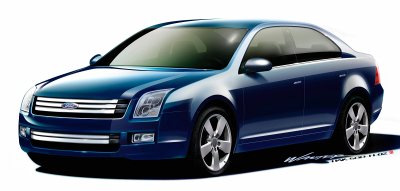
Photo: Ford
NEW YORK - Ford Motor Company announced at the New York Auto Show that it will follow the introduction of four all-new cars in 2004 with a new mid-size sedan in 2005 - the 2006 Ford Futura - as part of a comprehensive revitalization of the Ford brand's car line up. |
|
"We have an incredible array of new products coming next year - a freshened Focus, the Five Hundred, the Freestyle, the Ford GT and the all-new Mustang. But Ford's product-led revitalization - and the resurgence of our car business - will not end there," says Steve Lyons, president of Ford Division. "We're applying every lesson we have learned about vehicle interior design, packaging, driving dynamics and powertrain performance while adding a dose of design edge from the Ford 427 concept to create the new Ford Futura."
The Futura will be aimed squarely at the heart of the mid-size car market, where sedans like the Honda Accord have achieved considerable success. But the Futura has an all-American design - and is unmistakably a Ford car. It will boast world-class I-4 and V-6 engines and will come with a range of fuel efficient, modern transmissions, including manual, automatic and a continuously variable transmission (CVT) and many other best-in-class features.
Futura also will become Ford's second full hybrid vehicle.
The Ford Futura, Five Hundred and Freestyle are among the 65 new products Ford, Lincoln and Mercury will introduce in North America during the next five years. The Futura is built on a new vehicle architecture that will form the basis for up to 10 new products and 800,000 units of volume across all three brands within the next three years.
Unmistakably American
The Futura is designed to be immediately recognizable as an American car - and a Ford. It takes design inspiration and cues from the critically acclaimed Ford 427 concept car that is currently touring North American auto shows.
The Futura's profile is clean, smooth and unfettered by extraneous detail. The production Futura will borrow the vertical and linear front fascia from the 427 concept car, replete with its powerful thick bent bar grille inspired by some of Ford's landmark sedans from the 1960s.
Optimizing space for five passengers and all of the things people travel with - from water bottles to compact discs - was a priority for the Futura design team.
The Futura's interior will benefit from an unrelenting commitment to vehicle interior leadership. In fact, Ford has tripled its investment in interior design and development for Ford, Lincoln and Mercury vehicles during the past few years, which is already evident in the Lincoln Navigator and Aviator, the 2004 Ford F-150 and the Ford Freestar and Mercury Monterey minivans.
World-Class Powertrains - Including Ford's Second HEV
The Futura also will benefit from the massive investment Ford has made to develop powerful but lightweight and fuel-efficient engines and fuel-economy-boosting transmissions.
An all-aluminum 2.3-liter four-cylinder engine based on Ford's new global I-4 engine architecture will be standard. It will be fitted with a counter-rotating balance shaft for smoothness, and it will feature four valves per cylinder and variable intake valve timing (VVT) for good low-end torque, strong high-end power, improved fuel economy and low emissions. This engine weighs approximately 40 pounds less than Ford's current Zetec 2.0-liter I-4 engine.
Four-cylinder power will be a key to Futura's success:
Today's mid-size car segment leaders sell from 50 to 80 percent of their volume with four-cylinder engines. Approximately 25 percent of small-car buyers migrate to mid-size cars, and more than three-quarters of them purchase a four-cylinder model
The performance of Futura's four-cylinder engine will be significantly enhanced by modern, fuel efficient transmissions, while Futura's optional 3.0-liter Duratec V-6 engine will raise the performance bar even higher.
An additional Futura powerplant - which will be introduced after the 4- and 6-cylinder models enter production - will be the hybrid electric powertrain developed first for the Ford Escape Hybrid.
The Futura Hybrid, like the Escape Hybrid, mates a 2.3-liter I-4 gasoline engine with a 65-kilowatt electric motor. As a full hybrid, it will have the capability to run on full-battery power, the gas engine alone or gas and battery together. Full hybrids dramatically improve fuel economy and reduce emissions in city driving - particularly in "stop and go" traffic by shutting down the gasoline engine and running on battery power alone.
The gasoline engine starts on demand when the driver requires more acceleration. The gas engine also is used for steady-state highway cruising. The battery is recharged using regenerative braking. Performance will approach the level of the Duratec V-6, but with fuel economy better than a similarly sized four-cylinder car.
Car Resurgence
The launch of Ford's new car showroom will help drive important improvements to the brand's overall business structure.
The Futura's architecture, for example, was developed from a modified Mazda6 design. The Five Hundred and Freestyle also share a common vehicle architecture. All three products use engine architectures proven across a wide range of Ford, Lincoln, Mercury and Mazda products.
On the manufacturing side, Ford will use flexible manufacturing at the Chicago Assembly Plant to tailor production of Five Hundred and Freestyle to exactly line up with consumer demand.
Manufacturing plans for Futura will be announced at a later date.
With 10 new products and 800,000 units of volume within the next three years, the Futura platform will bring a whole new family of products to Ford, Lincoln and Mercury showrooms.
(April 16, 2003)
| .
Homepage News Companies Management Publications Events Careers Services Discussion Guestbook Search . |